 OGAE Serbia :: Vaš evrovizijski svet
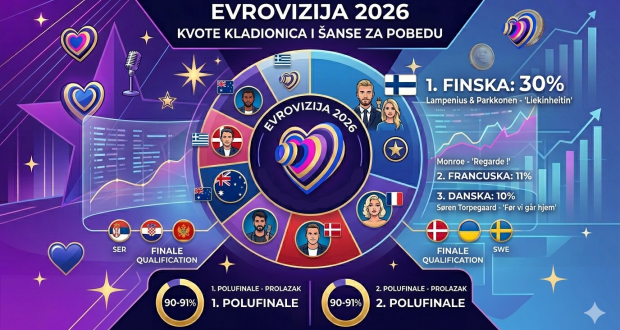
With less than a month to go until Eurovision 2026, the excitement among fans is reaching its peak. In this atmosphere, betting odds have already formed the first serious predictions and rankings, attracting increasing attention from the Eurovision community day by day.
Although it is still too early for final forecasts – as rehearsals, stage performances, and final impressions are yet to come and often change the course of the contest – the current odds still provide an insight into how the market sees this year’s favorites. At this stage, betting odds should not be viewed as a final verdict, but rather as an indicator of current mood, expectations, and song potential.
Despite this uncertainty, certain countries are already emerging as clear contenders for victory, while a wider group of competitors is forming just behind them, waiting for their chance. At the same time, an interesting situation is developing in the race for the final, where small percentage differences could determine the fate of participants.
Below, we bring a detailed analysis of the current betting situation – who is leading the race, who is in the top 5, and what chances the countries from the region and other participants have to reach the final.
Who Has the Best Chance to Win? Current TOP 5
As things currently stand in the betting odds, a group of five countries has emerged as the most realistic contenders for victory at Eurovision 2026. Although differences exist, it is clear that these countries will form the core of the battle for the top.
Finland – Lampenius & Parkkonen – “Liekinheitin” (around 30%)
Finland is the absolute leader of the betting odds and the only country with a double-digit percentage that significantly stands out from the competition. Their song Liekinheitin delivers an energetic and modern sound that is easy to remember, along with a strong visual identity that has already attracted fan attention.
The duo Lampenius & Parkkonen has managed to create a striking package that works both musically and visually. If the live performance meets expectations, Finland will be an extremely tough opponent for everyone else.
Representatives of Finland
France – Monroe – “Regarde !” (around 11%)
France is firmly holding second place with a song that radiates elegance and emotional depth. Regarde ! is a classic example of France’s Eurovision approach – focusing on interpretation, atmosphere, and authenticity.
As an artist, Monroe brings experience and confidence, and if the emotion is successfully conveyed on stage, France could seriously challenge the favorite.
Representative of France
Denmark – Søren Torpegaard – “Før vi går hjem” (around 10%)
Denmark has positioned itself as one of the most stable contenders at the top. The song Før vi går hjem combines modern production with an accessible melody, often a winning formula at Eurovision.
Søren Torpegaard gives the impression of a confident performer, and his song has the potential to reach a wide audience. However, to reach the very top, an additional standout moment will likely be needed.
Representative of Denmark
Australia – Delta Goodrem – “Eclipse” (around 8%)
A major name on the Eurovision stage, Delta Goodrem brings Eclipse, a song balancing between a radio hit and an emotional ballad. Australia traditionally invests heavily in staging, so a visually striking performance is expected.
The odds are slightly fluctuating, showing some uncertainty, but also the potential for Australia to “explode” after rehearsals.
Representative of Australia
Greece – Akylas – “Ferto” (around 8%)
Greece completes the top 5 with a song that brings an authentic sound and a captivating atmosphere. Ferto stands out with its distinctive style and can easily find its audience among voters.
Akylas has strong stage charisma, which could be crucial, and with a good performance Greece could become one of the main dark horse contenders.
Representative of Greece
Just behind the leading five are Noam Bettan (Israel) with “Michelle”, Felicia (Sweden) with “My System”, Romania’s A. Căpitănescu with “Choke Me”, Ukraine’s representative Leléka with “Ridnym”, and Italy’s Sal Da Vinci with “Per sempre sì”.
Although their winning chances are currently significantly lower, these countries should not be written off – the gaps are not impossible to close, and Eurovision history has repeatedly shown that a strong live performance can completely change the dynamics.
Serbia and the region – stable path to the final, but far from the top
When it comes to Serbia, our representatives, the group Lavina with the song Kraj mene, currently have no significant support from the betting odds in the race for victory – estimates are below 1%, placing them in the lower part of the table.
However, the situation looks significantly more positive when it comes to qualifying for the final. Serbia is among the safer candidates for qualification, with high percentages suggesting that reaching the final should be an achievable goal. In that sense, the real potential for a better result may only open after the live performance, where the biggest surprises often occur.
Looking at the rest of the Balkans, none of these countries are currently serious contenders for victory at Eurovision 2026, but their positions are much more interesting when it comes to qualifying for the final.
Lelek (Croatia) with the song Andromeda has less than a 1% chance of winning, but in the first semifinal stands quite well – around an 80% chance of qualification, making it one of the safer finalists.
Tamara Živković (Montenegro) also has minimal chances of winning (<1%), while in the first semifinal she is right on the qualification borderline with around 65%.
Alis (Albania) in the second semifinal shows a slightly better situation – although winning chances are also below 1%, qualification odds are around 75%, making her a relatively safe finalist.
Dara (Bulgaria) has around a 1% chance of winning overall, but in the second semifinal she is very stable with around 79% qualification chances, placing her among the safer finalists.
Overall, the Balkans do not currently have a strong top contender, but several countries have realistic chances of reaching the final – leaving room for potential improvement after live performances.
Representative of Montenegro
Qualification chances: What do the odds say?
Alongside the battle for victory, perhaps an even more interesting story lies in the Eurovision 2026 semifinals, where betting odds already clearly separate “safe qualifiers,” borderline acts, and outsiders. Although these predictions often change after rehearsals, they currently provide a strong overview of the competition.
First Semifinal – clear favorites and fight for the last spots
In the first semifinal, a group of near-certain qualifiers has emerged. At the very top are Finland’s Lampenius & Parkkonen, along with Sweden, Greece, and Israel – all of these countries have around or above a 90% chance of qualifying, meaning their elimination would be a major surprise.
Just behind them is Serbia with Lavina, who with around an 83% chance belongs to the group of safer qualifiers, together with Croatia, Moldova, and Lithuania. This means that anything other than qualification for these countries would be surprising, but not impossible.
A real drama is expected around the borderline – Georgia, Montenegro, and Poland are between 55% and 65%, placing them in a high-risk zone. These positions often depend on details such as running order, vocal performance, and staging impact.
At the bottom are Belgium, Portugal, Estonia, and especially San Marino, which with very low percentages is already considered an outsider in the race for the final.
Second Semifinal – mid-table crowding and uncertain race
The second semifinal presents a slightly different picture – although there are clear favorites, the differences between participants are smaller, suggesting a more unpredictable battle.
At the top are Denmark, Ukraine, and Australia, all with around 90% qualification chances, making them safe finalists. Behind them is a group of very stable candidates – Romania, Cyprus, Bulgaria, Czechia, and Malta – with around 75–80% chances.
Unlike the first semifinal, the “danger zone” here is much wider. Albania and Norway are around 70–75%, while Latvia, Armenia, and Switzerland sit between qualification safety and elimination risk. This is where the most changes are expected after rehearsals.
At the bottom are Luxembourg and Azerbaijan, with Azerbaijan practically having no realistic chance of qualifying at this moment due to single-digit percentages.
Conclusion – a clear favorite, but the race is still open
As things currently stand, betting odds for Eurovision 2026 clearly highlight Finland as the main favorite, with France and Denmark as the closest challengers. However, the gaps behind the leader are not insurmountable, and experience shows that the balance of power can change significantly after rehearsals and live performances.
The battle for qualification looks somewhat more predictable, but even there nothing is guaranteed – especially in the middle of the table where small details decide everything. This is often where the biggest surprises happen, while some favorites fail when the lights go on.
For Serbia and its representatives, Lavina, the focus is clearly on securing a place in the final, which currently looks very achievable. Anything beyond that will depend on staging and overall live impression.
Ultimately, betting odds provide a framework and guidance, but Eurovision year after year proves that the winner is not determined by numbers – but by the moment, emotion, and a performance that the audience remembers.
Representative of Serbia